Local Storage seems to be disabled in your browser.
For the best experience on our site, be sure to turn on Local Storage in your browser.

Ancient World Coins


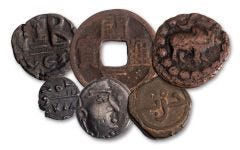
Ancient coins were more than just money in the times they circulated, they were also considered pieces of art. Such coins allowed civilizations to represent both their deities and values in miniature sculptures struck in precious metals. Ancient coins tell the story of early civilizations through the Greek and Roman Empires and beyond to Biblical times, the Middle Ages, and the Renaissance. If Ancient coins could talk, what a story they would tell, from the people who designed and minted them, to the many hands these ancient coins may have passed through. Throughout history, countless nations have risen and eventually crumbled, leaving the coins that survived, as tangible clues to ancient culture.
Today, ancient coins are still widely purchased and collected. Like most collectible coins, there is even a market for certified ancients from top-tier, third party grading companies. No matter what your preference, ancient coins are an exciting and rewarding way to enhance your collection, with a rich history that can be seen in the magnificent designs on these notable coins. Ancient coins have survived for generations and will continue to both be appreciated and utilized to teach future generations, making Ancient coins, truly timeless.
-
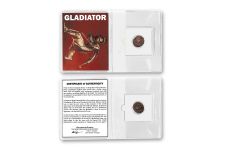
AD 337–361 Bronze Half-Centenionalis Constantius II Gladiator Coin
$28.95 As Low As $28.10- Qty Credit Card Wire
- 1+ $28.95 $28.10
In Stock -
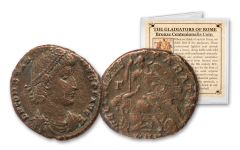
A.D. 355–361 Bronze Centenionalis Constantius II Gladiator Coin
$80.95 As Low As $78.56- Qty Credit Card Wire
- 1+ $80.95 $78.56
Available for Order -
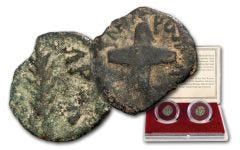
A.D. 37–95 Judea Bronze Prutah Paul the Apostle 2-pc Set
$114.95 As Low As $111.56- Qty Credit Card Wire
- 1+ $114.95 $111.56
In Stock -
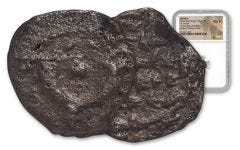
Ancient Widows Mite Bronze Prutah NGC CH F
$91.95 As Low As $89.24- Qty Credit Card Wire
- 1+ $91.95 $89.24
In Stock -
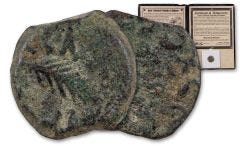
AD 58–62 Roman Bronze Prutah of Judea
$67.95 As Low As $65.95- Qty Credit Card Wire
- 1+ $67.95 $65.95
In Stock -
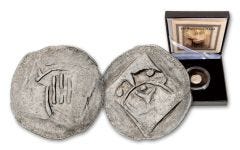
1250–1331 Schwabisch Hall Silver Right Hand of God Heller Coin
$57.95 As Low As $56.24- Qty Credit Card Wire
- 1+ $57.95 $56.24
In Stock -

1711-D France Billon 30 Denier New World Hoard PCGS Genuine
$99.00 As Low As $96.08- Qty Credit Card Wire
- 1+ $99.00 $96.08
In Stock -
-
A Brief Timeline
Ancient coinage really took off in early Greek civilization, and can be divided into three time frames, Archaic, Classical, and Hellenistic eras, which all together span more than seven centuries. The Archaic period extends from around 700 BC until the Persian Wars in about 480 BC. The Classical period ended around 323 BC with the conquests of Alexander the Great. The Hellenistic period concluded around 30 BC with the Roman absorption of the ancient Greek world.
The Archaic Period
Some of the first coins to ever be circulated were minted during the Archaic period over 2,500 years ago, by wealthy King Croesus of Lydia, which is now the coast of modern-day turkey. The Lydians’ were early entrepreneurs who needed small forms of monetary exchange in a standardized precious metal form. This need inspired the first coins in the world which carried a symbolic design to authenticate their value. These early examples of coins were minted from lumps of electrum, a naturally occurring gold and silver alloy, that was highly prized and abundant in the region.
Classical Greek Coinage
Greek coinage reached a high level of aesthetic and technical quality in the Classical period. Early Greek coinage is often considered as ancient art. Two beautiful examples of this artistry in early coins are the Greek Turtle Silver Stater from the Island of Aegina and the Greek Athena Owl coin, a beautiful silver tetradrachm. Special Olympic Staters were produced only during the Olympic games to support the temporary economy and act as a commemorative coin of the events.
It was these Ancient coin designs that inspired President, Theodore Roosevelt to elevate American coinage to the level of these works of art. Roosevelt would then go on to enlist sculptor Augustus Saint-Gaudens to design some of the most beautiful American coins to ever be produced.
Hellenistic Period
During the Hellenistic period, coins featured the portraits of Hellenistic kings like Alexander the Great and other successor kings. Today, such portraits give us a realistic look at the faces of many historical figures from the ancient world on the obverse, juxtaposed with imagery of victorious conquests and political propaganda.
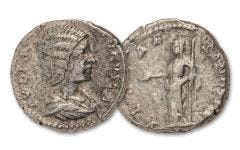
Hellenistic coinage was succeeded by what numismatists refer to as Roman Imperatorial Coinage. Such coinage from the Roman Empire would feature the likenesses of Julius and Augustus Caesar and even those of Cleopatra and Marc Antony. Today, assembling a 12 Caesar set in either gold or silver is an exciting and rewarding adventure to pursue. The true visages of world rulers over the centuries were recorded for posterity, and many of these rulers are unknown to history except through their realistic coin portraits that we see on these Ancient coins.
Judean Coins
The Judaeo-Christian religions are well represented by coins as well. Many such coins refer to events in the New Testament like ancient Widow's Mite Bronze Lepton, the Tribute Penny, and the Coin in the Fish's Mouth.
A Brief Timeline of Ancient Coins
Ancient coinage really took off in early Greek civilization, and can be divided into three time frames, Archaic, Classical, and Hellenistic eras, which all together span more than seven centuries. The Archaic period extends from around 800 BC until the Persian Wars in about 480 BC. The Classical period ended around 323 BC with the conquests of Alexander the Great. The Hellenistic period concluded around 30 BC with the Roman absorption of the ancient Greek world.
The Archaic Period
Some of the first ancient Greek coins to ever be circulated were minted during the Archaic period over 2,500 years ago, by wealthy King Croesus of Lydia, which is now the coast of modern-day turkey. The Lydians’ were early entrepreneurs who needed small forms of monetary exchange in a standardized precious metal form. This need inspired the first coins in the world which carried a symbolic design to authenticate their value. These ancient silver coins were minted from lumps of electrum, a naturally occurring gold and silver alloy, that was highly prized and abundant in the region.
Classical Greek Coinage
Greek coinage reached a high level of aesthetic and technical quality in the Classical period. Early Greek coinage is often considered as ancient art. Two beautiful examples of this artistry in early coins are the Greek Turtle Silver Stater from the Island of Aegina and the Greek Athena Owl coin, a beautiful silver tetradrachm. Special Olympic Staters were produced only during the Olympic games to support the temporary economy and act as a commemorative coin of the events.
It was these Ancient coin designs that inspired President Theodore Roosevelt to elevate American coinage to the level of these works of art. Roosevelt would then go on to enlist sculptor Augustus Saint-Gaudens to design some of the most beautiful American coins to ever be produced.
Hellenistic Period
During the Hellenistic period, coins featured the portraits of Hellenistic kings like Alexander the Great and other successor kings. Today, such portraits give us a realistic look at the faces of many historical figures from the ancient world on the obverse, juxtaposed with imagery of victorious conquests and political propaganda.
Hellenistic coinage was succeeded by what numismatists refer to as Roman Imperatorial Coinage. Such ancient Roman coins would feature the likenesses of Julius and Augustus Caesar and even those of Cleopatra and Marc Antony. Today, assembling a 12 Caesar set in either gold or silver is an exciting and rewarding adventure to pursue. The true visages of world rulers over the centuries were recorded for posterity, and many of these rulers are unknown to history except through their realistic coin portraits that we see on these Ancient coins.
Judean Coins
The Judaeo-Christian religions are well represented by coins as well. Many such coins refer to events in the New Testament like ancient Widow's Mite Bronze Lepton, the Tribute Penny, and the Coin in the Fish's Mouth.
Which Ancient Coins Are Especially Collectible?
Most ancient coins were used by everyday people, but like modern coins, there were a number of ancient coins that really made a historical impact due to their significance to Western culture, achievements in numismatics, or are simply rare because of only a handful of coins remaining.
Today, some of the most expensive ancient coins in the world are:
- ‘EID MAR’ denarius of Brutus coin - ~$3.3 Million
- 723 Umayyad gold dinar - ~$4.8 Million
- 1343 Edward III Florin - ~$6.8 Million
Coin collecting and ancient numismatics were a prestigious “king’s hobby” back when such mints made coins. This prestigious endeavor, in turn, fostered the introduction of forgeries and counterfeit coins. These ancient numismatists fine-tuned this academic pursuit of coin collecting which has allowed for the variety of guides and resources we use today in modern numismatics.
What Materials Are Ancient Coins Made Of?
Ancient coins varied in both alloy and composition. While many were made from gold, silver, and copper, there were a number of alloys like electrum (alloy of gold and at least 20 percent silver), a variety of different bronze or brass combinations, and even lead/lead bronze.
The earliest coins from Asia Minor in the late seventh century B.C. were often minted from naturally-occurring electrum before being quickly replaced by coins of just silver. Gold coins were not common until the age of the father of Alexander the Great, Philip II.
During the Greek and Roman empires, these ancient gold coins consistently had high purity of 95 percent or more. Ancient silver coins had an equally high purity until the Roman emperor Nero lowered the silver content, which ultimately led silver coins to contain as little as 2.5 percent silver.
Coins of copper alloys were not common until the late 4th century B.C. and were some of the first token coins minted. The Greeks used mainly bronze, copper alloyed with tin, or simply copper for their token coinage while the Romans used a yellowish alloy of copper and zinc, a type of brass called orichalcum, and a more red copper alloy.
How Can You Tell If an Ancient Coin Is Real?
Weight, metal composition, quality of engraving, design diameter, edge, and missing details are all factors to take into consideration when delving into ancient coin collecting. It is an in-depth process to determine the veracity of any ancient coin. However, despite the fears around fake ancient coins scaring off potential collectors, some of even the most ancient fakes are not that big of an issue for an expert or even a well-informed beginner. It simply takes a little research and attention to detail to tell the difference between a fake ancient coin and an authentically minted one. Others can be harder to detect and will necessitate an advanced understanding of ancient numismatics.
There can be two major types of fakes with ancient coins meant to deceive the collector:
One, the harder to find the coin is, the less likely that there is common knowledge available to the general public. Because of the potential profit from selling a counterfeit of this caliber, the details in the replica will probably respect weight, diameter, style, etc. On the other hand, coins of this nature will inevitably have marks and leave traces from modern manufacturing techniques. In general, fake coins of this nature are a very small fraction of counterfeits.
The second type of counterfeit is the cheaper, more common ancient coin. There are several things to consider here, but the major factor in this instance is that there will be a number of coins with the exact same centering, which is an impossible factor when it comes to ancient coins as they were often minted by hammer and anvil. If you see two coins of the same type with the same centering, it is no doubt a modern fake.
Buying Ancient Coins from GovMint.com
The best way for a collector to avoid fake ancient coins is to purchase only from reputable dealers. Since 1984, GovMint.com has been one of the largest collectible coin marketers in the country, and through our various endeavors, we have been able to provide collectors like you with many leading-edge product introductions and new innovations in the collecting field.
GovMint.com is an authorized dealer for coins that are authenticated, certified, and graded by Numismatic Guaranty Corporation (NGC) and Professional Coin Grading Service (PCGS), and with our A+ Better Business Bureau rating, all this further indicates the highest degree of confidence in our operations and customer service.